Showing posts with label Jean Arp. Show all posts

Tuesday, December 11, 2018

The Nature of Arp, Part Four

The fourth and fifth grade students had a little extra time for one last stop during The Nature of Arp tour. We played a quick drawing game using a piece of paper folded into three equal sections. Students had one minute to draw whatever they wanted in the top section of the paper. At the end of the minute, they folded the paper so their drawing was hidden and passed it to the student next to them. Students had another minute to draw, now in the middle section. At the end of the minute, they refolded the paper so both drawings were hidden and passed it to the student next to them. Students then had one last minute to draw, now in the bottom section. Once all sections were filled in, students unfolded their paper to reveal how all the parts came together to make one drawing!

4th grade
5th grade 
4th grade
5th grade

The Big Reveal!!


4th grade
5th grade
4th grade
4th grade
5th grade
5th grade

Our game was inspired by a collaborative drawing approach invented in 1925 called exquisite corpse. We ended our tour by looking at an exquisite corpse drawing made by Arp, his wife, and two of their friends. Their exquisite corpse also incorporated torn pieces of paper glued onto the drawing. Marcel Jean drew in the top section, Oscar Dominguez drew in the second section, Arp collaged paper pieces in the third section, and his wife Sophie Taeuber-Arp collaged in the bottom section. Just as our Mad-lib during the previous stop used chance to fill in missing words, the completed group drawing was completely unplanned and unknown until the students unfolded their paper at the end of our game.

Exquisite Corpse; collaborative work by (from top to bottom) Marcel Jean, Oscar Dominguez, Jean Arp, Sophie Taueber-Arp

Tuesday, December 4, 2018

The Nature of Arp Tour, Part Three

Before moving on to our next sculpture, we filled out a Mad Lib together. I asked volunteers to raise their hands and give me examples of adjectives, verbs, nouns, and body parts to fill in the blanks below:
3rd grade
4th grade
We read aloud our (sometimes silly) poems. This Mad Lib is based on a poem written by Jean Arp.  Below is his version:

i awoke from a deep and dreamless sleep
with disagreeable objects on my face
sophie said they were a big fly a mustache
and a little mandolin
i had no intention whatsoever of removing them
quite the opposite
i remained motionless so that they wouldn’t fall from my face

Afterward, we looked for a sculpture that seemed to connect with this poem.
3rd grade
3rd grade
4th grade
5th grade
5th grade
Sculptures are often one big piece.  In Three Disagreeable Objects on a FaceArp created a sculpture made of multiple parts. Do any of the small pieces look like a big fly, a mustache, or a little mandolin from Arp's poem?

These small pieces are not attached to the large piece that they rest on. Arp allowed viewers to move the parts around as they chose, so he could not plan or control how the sculpture looked. Where would you place the small pieces if you were allowed to rearrange this sculpture? 

Three Disagreeable Objects on a Face by Jean Arp


Tuesday, November 27, 2018

The Nature of Arp Tour, Part Two

We visited these seven prints at the next stop in our tour.  As with our first stop, we shared shapes that we recognized in these artworks.  What shapes do you see?


The students saw so many different shapes in these prints - we could have spent an entire hour sharing what we saw! 


3rd grade
3rd grade
4th grade
4th grade
5th grade
Below are some popular responses from students, along with the titles that Arp gave his prints.


Arp created these for a magazine that was published by an artist friend of his named Kurt Schwitters. He combines two different things in some of his prints, such as Mustache Hat and The Navel Bottle, so you could call these hybrids.  They are also examples of abstract shapes. 

In the prints above and the wood reliefs from the first stop in our tour, we see that Arp often uses body parts or things we wear on our bodies (mustache, hat, shirtfront, watch) and natural things (bird, horse, the sea).

Arp loved to create artwork by chance. What does that mean? To do something without planning, by accident, or when something happens on its own without you controlling the outcome or the result.

To get an idea of how it feels to make art by chance, each student was randomly assigned a number 1 through 5.

Then, I drew a word out of two separate bags for each group to combine together into a single hybrid drawing.  One word related to nature, and the other word related to the body or things we wear on our bodies. 

3rd grade
3rd grade
4th grade
4th grade
5th grade
5th grade
5th grade

Sample random combinations were bee + thought bubble, high heel + rainbow, and horse + hat. The drawings were super fun!

3rd grade
4th grade
5th grade


Tuesday, November 13, 2018

The Nature of Arp Tour, Part One

It's always such a treat to see everyone at the first tour of the year. Everyone is a little taller (well, except for me). Everyone is a little excited (I'm a LOT excited). And, I'm pretty sure I see the same anticipation that I feel inside reflected in the bright and shining faces looking back at me.  :) 

Visit 1 Vocabulary:
relief / el relieve  
hybrid / el híbrido 
abstract / abstracto
biomorphic / biomorfo
chance / el azar 
collaborate / colaborar

During our first tour of the year, we explored the special exhibition The Nature of ArpWhat is nature? Can you name some examples of nature? Nature also refers to the characteristics of something or someone.  So, The Nature of Arp could also mean The Characteristics of Arp.  As we visited different works of art, we looked for things from nature as well as things that might tell us what kind of person Jean Arp was.

We began by looking at the works of art below and pointing out shapes that look familiar to us. What do you see?


These artworks are called (from left to right) Shirtfront and Fork, Horse-Bird, and Bird-Man. Where do you see these shapes? How much do they look like the titles – a lot, or a little, or in somewhere in between?

3rd grade
3rd grade
The artist, Jean Arp, used abstract shapes in his artwork. For example, he creates a shape that is inspired by something like a fork or a bird, with simple outlines and not much detail. It might not look exactly like the object that inspired it. Arp also mixes together two things in Horse-Bird and Bird-Man. We can call this a hybrid – when two or more things are combined.

4th grade (sometimes it helps to look sideways)  :)
4th grade
These artworks are made of painted wood.  Arp designed the shapes, then he worked with skilled carpenters to cut the shapes for him.  Arp liked to collaborate, or work together, with friends, artists, and people with different skills when he made art. Once the wood shapes were cut, Arp painted and combined them to make these reliefs. A relief is a work of art, usually hung on a wall or maybe part of a building, with 3-D parts that are carved from or attached to a flat background.

5th grade
5th grade

Stay tuned for pictures from the next stop in The Nature of Arp tour!

*I usually include pictures from all grades in these blog posts, but the 2nd grade tour has been postponed until early December.  So the 2nd graders will get their own picture post after their tour.  :)


Thursday, March 22, 2018

Collecting and Collections Tour, Part One

During our tour last month, we explored the idea of collecting and collections.  What do you collect, and why? How do you choose what to add to your collection?

Mr. and Mrs. Raymond and Patsy Nasher loved to collect modern and contemporary sculpture.  They built the Nasher Sculpture Center so anyone can come and enjoy the Nasher collection as well as special exhibitions featuring the work of artists from around the world.

Visit 3 Vocabulary:
collection / la colección
series / la serie
biomorphic / biomorfo
abstract / abstracto
curator / el curador / la curadora

We began by looking closely at this sculpture, first by sketching and then by tracing its outline with our finger.


Torso with Buds by Jean Arp
2nd grade
4th grade
5th grade
2nd grade
3rd grade
4th grade
5th grade

Jean Arp, the sculptor, is well known for sculptures with curving outlines. Sculptures like this one are described as biomorphic. In other words, this sculpture resembles the shape and forms of nature and living things.  

This sculpture is called Torso with Buds. How does this sculpture combine a torso with buds? Torso with Buds is part of a series that combines human and plant forms. When an artist creates multiple works of art that are similar – maybe the same subject, the same style, the same art material, and/or the same colors – it’s called a series.

One year, Patsy Nasher surprised her husband Raymond with this sculpture as a gift for his birthday. From then on, the sculpture enjoyed a special place in the entryway of their home.  Can you find the sculpture?


Hint: look near the back of the room
2nd grade
2nd grade
4th grade
5th grade
Next, we looked at two sculptures that are part of a series by artist Alberto Giacometti.  How would you describe the texture of these sculptures?  How are they alike and different?


Venice Woman III (left) and Venice Woman IV (right) by Alberto Giacometti
2nd grade
3rd grade
3rd grade
3rd grade
4th grade
5th grade
Students took turns standing like each of the figures.


2nd grade
4th grade
5th grade
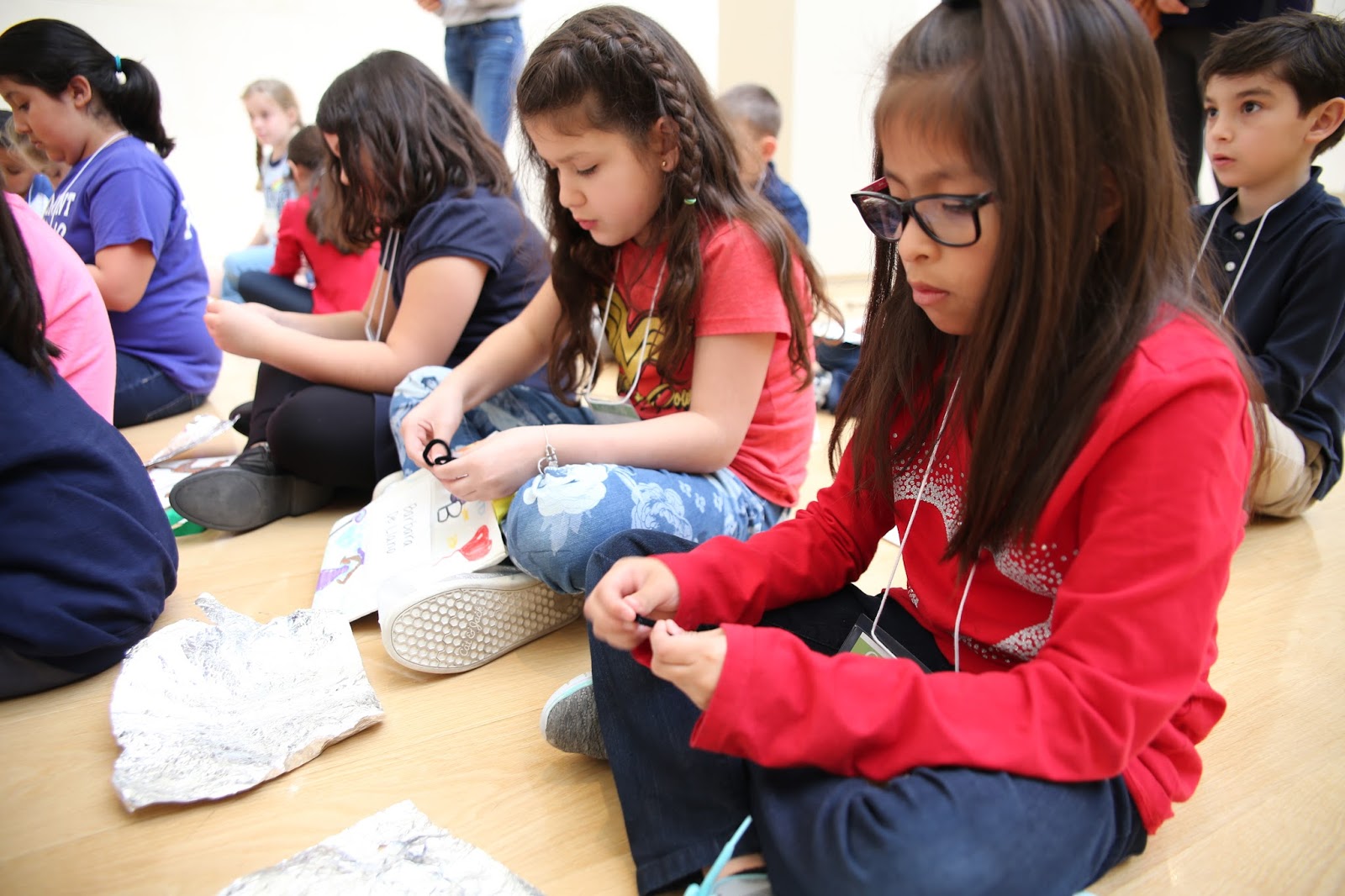
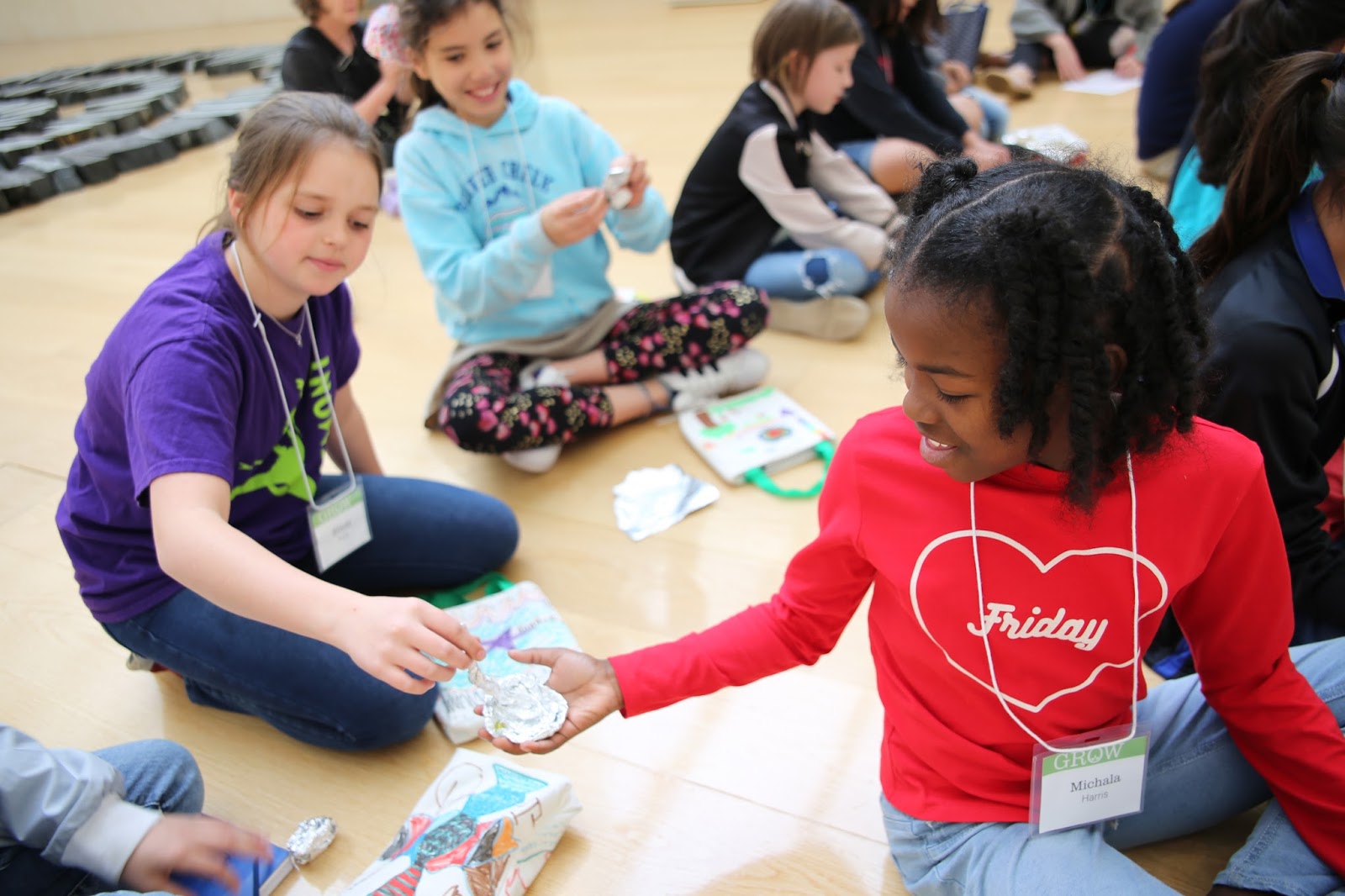
Then, students made their own abstract sculptures using pipe cleaners and aluminum foil.


2nd grade
2nd grade
2nd grade
4th grade
4th grade
5th grade
5th grade
5th grade
On our way to the next stop, we took a quick look at at two very small sculptures by the same artist, Alberto Giacometti.  We had just looked at Venice Woman III and Venice Woman IV, which are each almost four feet tall.  These two sculptures, Small Standing Woman and Small Standing Man, are each less than 2 inches tall!


Small Standing Woman (left) and Small Standing Man (right) by Alberto Giacometti


4th grade
5th grade