Thursday, March 22, 2018

Collecting and Collections Tour, Part One

During our tour last month, we explored the idea of collecting and collections.  What do you collect, and why? How do you choose what to add to your collection?

Mr. and Mrs. Raymond and Patsy Nasher loved to collect modern and contemporary sculpture.  They built the Nasher Sculpture Center so anyone can come and enjoy the Nasher collection as well as special exhibitions featuring the work of artists from around the world.

Visit 3 Vocabulary:
collection / la colección
series / la serie
biomorphic / biomorfo
abstract / abstracto
curator / el curador / la curadora

We began by looking closely at this sculpture, first by sketching and then by tracing its outline with our finger.


Torso with Buds by Jean Arp
2nd grade
4th grade
5th grade
2nd grade
3rd grade
4th grade
5th grade

Jean Arp, the sculptor, is well known for sculptures with curving outlines. Sculptures like this one are described as biomorphic. In other words, this sculpture resembles the shape and forms of nature and living things.  

This sculpture is called Torso with Buds. How does this sculpture combine a torso with buds? Torso with Buds is part of a series that combines human and plant forms. When an artist creates multiple works of art that are similar – maybe the same subject, the same style, the same art material, and/or the same colors – it’s called a series.

One year, Patsy Nasher surprised her husband Raymond with this sculpture as a gift for his birthday. From then on, the sculpture enjoyed a special place in the entryway of their home.  Can you find the sculpture?


Hint: look near the back of the room
2nd grade
2nd grade
4th grade
5th grade
Next, we looked at two sculptures that are part of a series by artist Alberto Giacometti.  How would you describe the texture of these sculptures?  How are they alike and different?


Venice Woman III (left) and Venice Woman IV (right) by Alberto Giacometti
2nd grade
3rd grade
3rd grade
3rd grade
4th grade
5th grade
Students took turns standing like each of the figures.


2nd grade
4th grade
5th grade
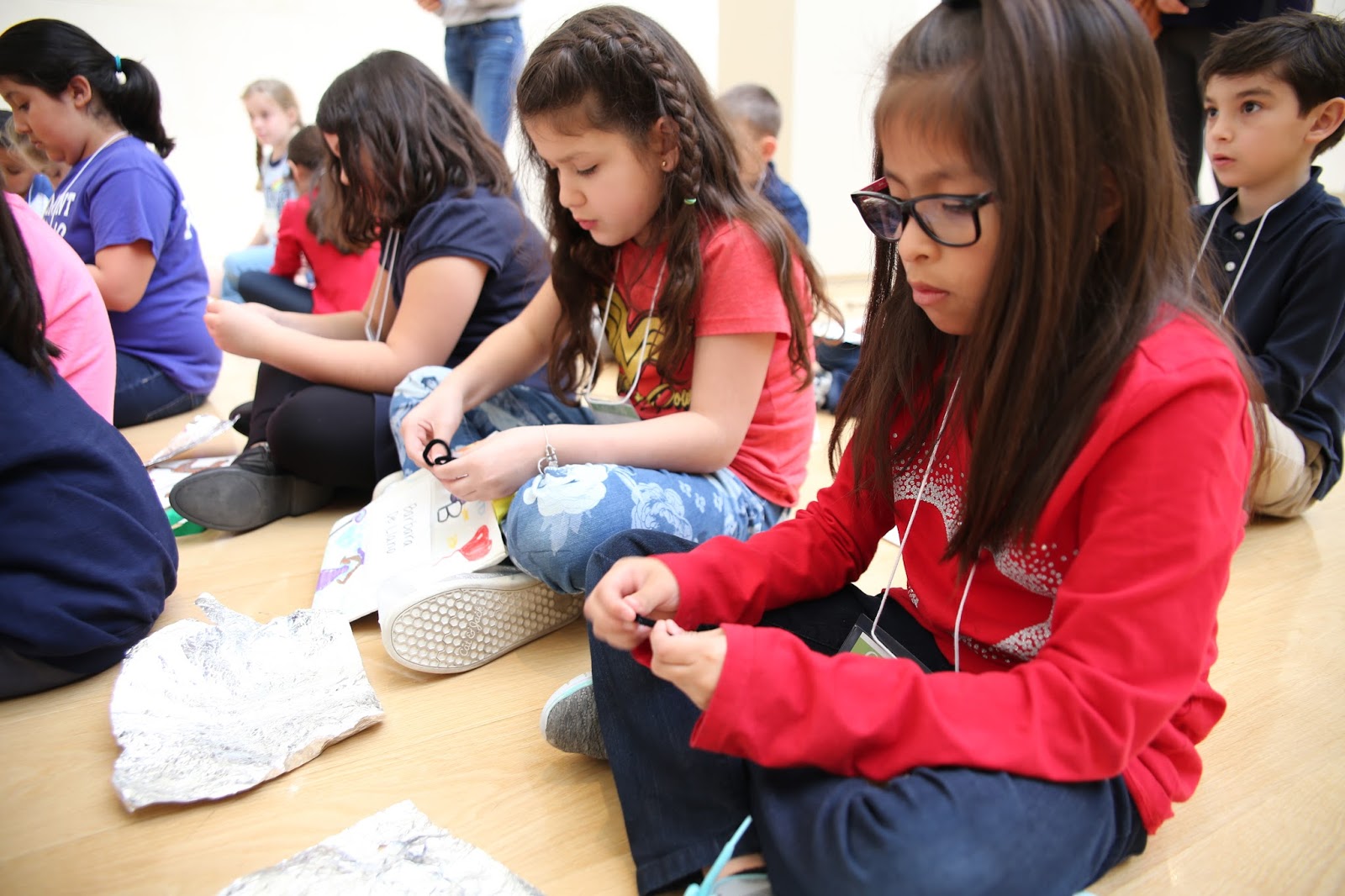
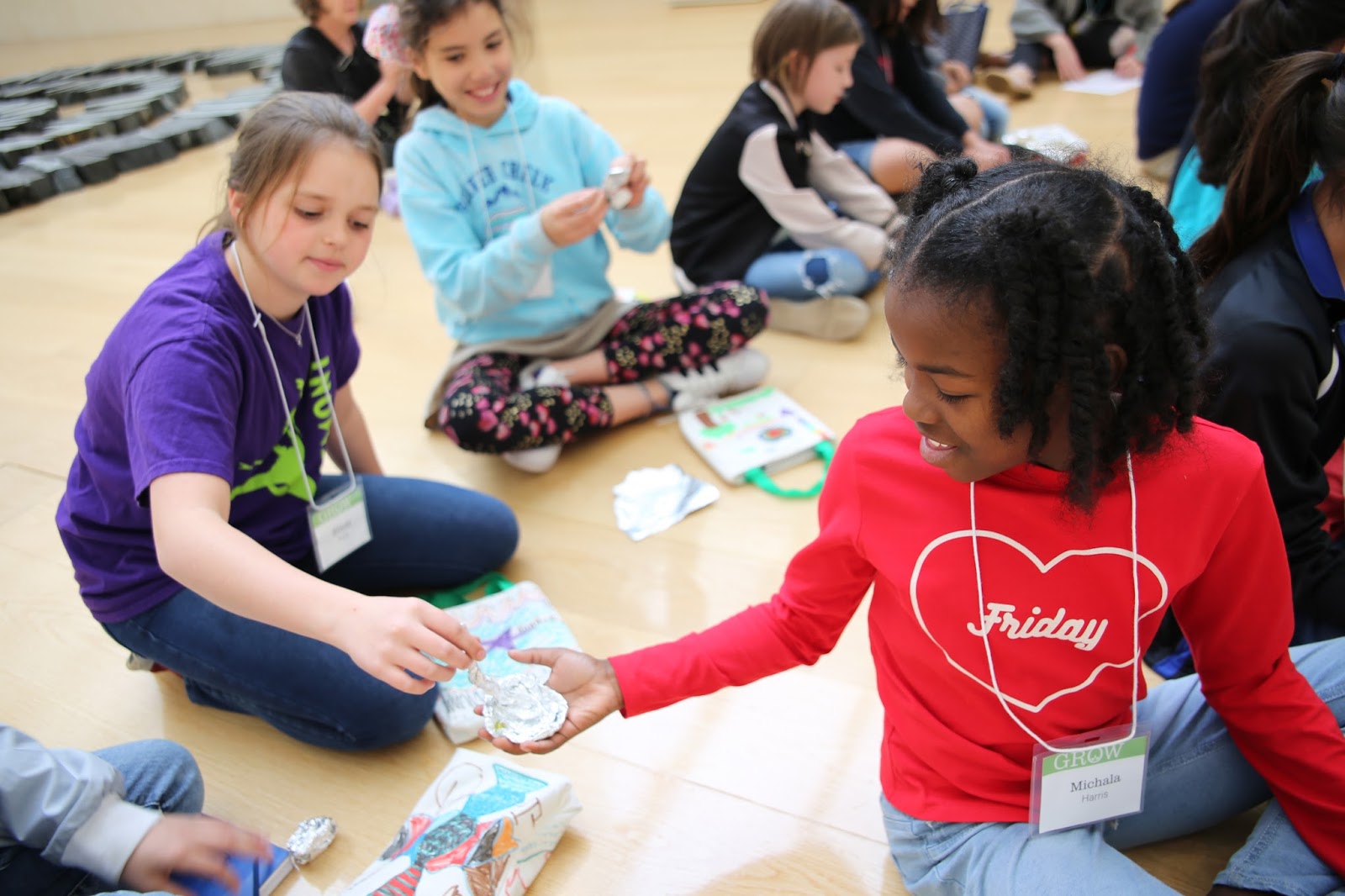
Then, students made their own abstract sculptures using pipe cleaners and aluminum foil.


2nd grade
2nd grade
2nd grade
4th grade
4th grade
5th grade
5th grade
5th grade
On our way to the next stop, we took a quick look at at two very small sculptures by the same artist, Alberto Giacometti.  We had just looked at Venice Woman III and Venice Woman IV, which are each almost four feet tall.  These two sculptures, Small Standing Woman and Small Standing Man, are each less than 2 inches tall!


Small Standing Woman (left) and Small Standing Man (right) by Alberto Giacometti


4th grade
5th grade


Tuesday, February 6, 2018

Paper into Sculpture Tour, Part Two

We finished our tour in the special exhibition The DRAMASTICS: A Punk Rock Victory Twister in Texas. Students began by describing the colors, shapes, and scenes showing a fictional all-female punk rock band called The DRAMASTICS.


3rd grade
3rd grade
4th grade
4th grade
5th grade
The artist, Nathan Carter, created a narrative or story around the band using paper figures and stages to show different places around the world where The DRAMASTICS performed.  He then used these paper figures and sets to produce a film about the band.

Carter also designed outfits the band might wear during performances and t-shirts that fans might buy at their concerts.

The students finished the tour by imagining their own fictional bands - inventing their band names, designing outfits and concert t-shirts.


4th grade
4th grade
5th grade
5th grade

Thursday, February 1, 2018

Paper into Sculpture Tour, Part One

How many ways can you change or manipulate a piece of paper?

At the beginning of our second tour, students made a list of ways to manipulate paper that included cut, tear, burn, draw, paint, shred, crumple, and fold.  Keeping these actions in mind, we entered the special exhibition Paper into Sculpture.  Side note: the students were REALLY excited to go into the downstairs gallery.  I guess we hadn't spent any time downstairs in recent years?  :)

Visit 2 Vocabulary:
paper / papel
manipulate / manipular
feeling / la emoción
fictional / ficticio
narrative / narración / la historia


3rd grade
4th grade
5th grade
Inside the exhibit, we saw works of art by five artists who used paper in different ways.  As I read our list of actions aloud, students pointed to the sculptures where it seemed like the artist used that technique.  In some cases, students pointed to more than one sculpture.  (P.S. pointing is fun!)


3rd grade
3rd grade
4th grade
4th grade
5th grade
After reviewing our list, we focused on the following artwork by Nancy Rubins.


Drawing by Nancy Rubins
Students began by describing the work of art, then guessing how the artist made it.  Just about everyone was shocked to learn that Rubins used two very simple materials: pencil and paper.  To be specific, she used large sheets of watercolor paper, which is thicker and has a more textured surface than notebook paper.  Rubins covers the paper with graphite from carpenter's pencils, which are rectangular in shape (as opposed to the round shape of standard writing or drawing pencils).  To get a small sense of how long it might have taken Rubins to make this artwork, students took 30 seconds to see how much of their paper they could cover with their pencils.  Considering this artwork is 31 1/2 feet wide, 11 feet tall, and covered with multiple layers of graphite, it must have taken Rubins much longer than 30 seconds!


3rd grade
3rd grade
3rd grade
3rd grade
4th grade
5th grade
5th grade
The name of this artwork is Drawing. It is included in an exhibition called Paper into Sculpture. Would you call this work of art a drawing, or sculpture, or both?

Next we looked at an artwork that some of the students walked right by without noticing.  Can you see it in these photos?


3rd grade
4th grade
5th grade
5th grade
Quite a few visitors walk right by this artwork without noticing it, partly because it is made of tiny little pieces, and partly because it is made of small white shapes installed on a white wall.  Here are some close-up photos.


Language Shower by Marco Maggi, detail
This artwork by artist Marco Maggi, titled Language Shower, extends from floor to ceiling and is almost as wide as half the wall.  It is difficult to take a photograph of the entire artwork because the further back you step, the less you are able to see the individual shapes and pieces. We must get close to see the little shapes, but we must step back to see how high and wide the artwork stretches. There is no one perfect spot to view the whole thing.

Maggi creates his artworks by cutting small, precise shapes out of self-adhesive labels, which he applies directly to the wall.  He uses a utility blade to cut the shapes, which he does not draw beforehand.  The shapes are rarely flat against the wall, but often extend away from the wall at least a little. 

Maggi calls works like these "shy sculptures."  What do you think he means by this?  Think about Drawing by Nancy Rubins.  What feeling do you connect with that artwork?

After discussing these artworks, the 4th and 5th graders divided into groups.  Each group was given two of the following verbs: tear, fold, crumple, roll, draw, and color.  Everyone received a sheet of paper, which s/he made into a work of art using one or both of their verbs.


4th grade
4th grade
5th grade 
5th grade


5th grade


.