Tuesday, May 3, 2016

The Figure Tour, Part Two

For the second part of The Figure tour, we headed outside and walked all the way around Untitled by Joel Shapiro.  
Joel Shapiro, Untitled, 1996-99
2nd grade


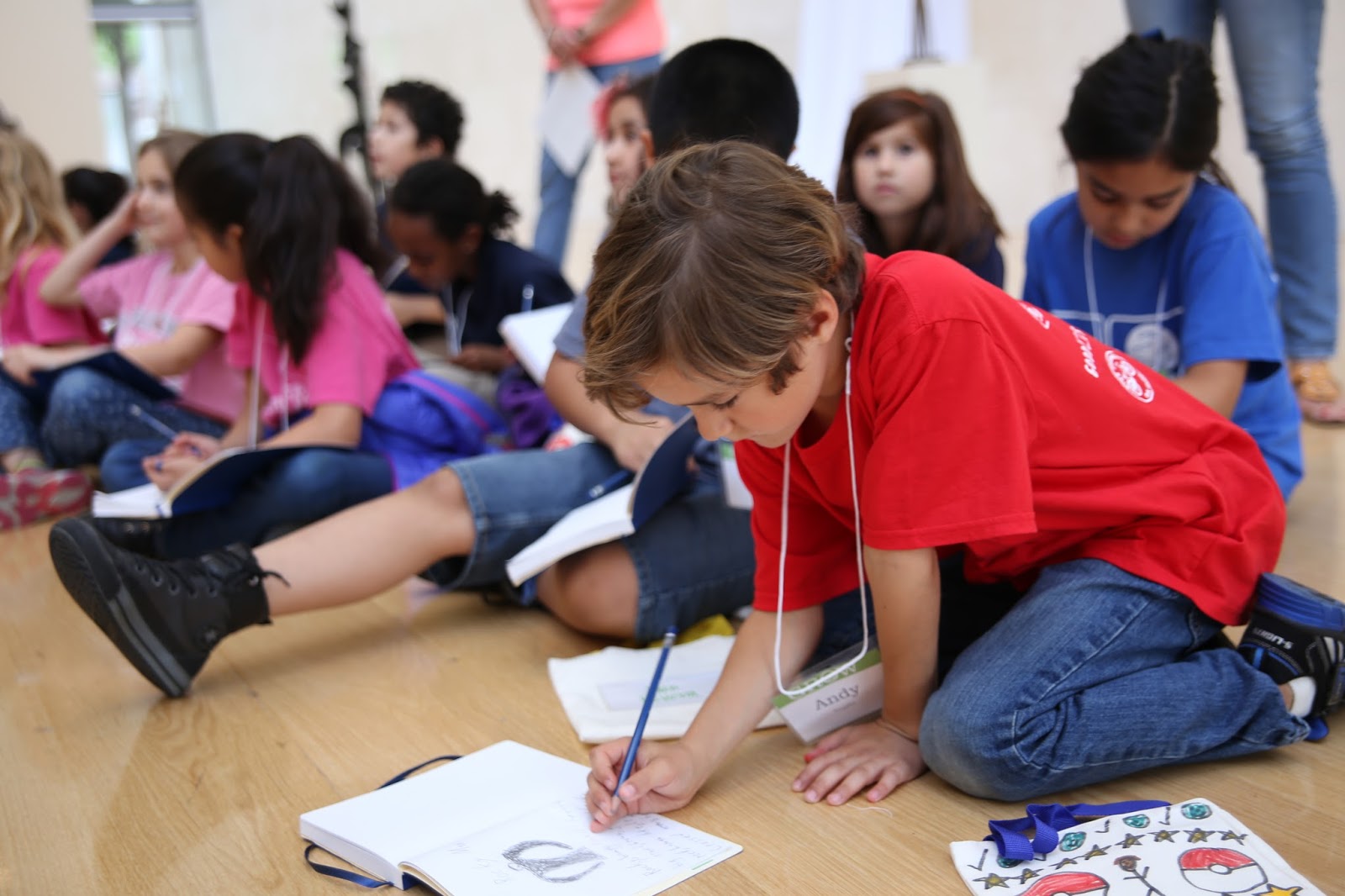
Joel Shapiro has mentioned two things that inspire his work: trees and the figure.  The students discussed how this sculpture reminded them of one or the other, or both.  To help understand how the sculpture might relate to the figure, they used their best balancing skills as they tried to position their bodies like Untitled.

3rd grade

4th grade
Think about the vocabulary words for this tour.  Do you consider this sculpture to be more realistic or more abstract?  Why do you say so?

And don't forget to SAVE THE DATE for Rosemont Family Day at the Nasher Sculpture Center from 12:00-2:00 p.m. on Saturday, May 14.  We look forward to seeing you!

Tuesday, April 26, 2016

The Figure Tour, Part One

For our final tour of the 2015-16 school year, we focused on the figure.  All the works of art that we viewed include or refer to the human body, or figure, in some way.  

Visit 3 Vocabulary: 


figure / figura
bust / busto
portrait / retrato
realistic / realista
abstract / abstracto
profile / perfil

We began by comparing and contrasting sculptures by Willem de Kooning and Alberto Giacometti.  How many similarities and differences can you find?

Willem de Kooning, Clamdigger, 1972


Alberto Giacometti; Bust of Diego, 1954 (left), Diego in a Sweater, 1953 (middle), Diego in a Cloak, 1954 (right)
The students divided into pairs, and each person was given a challenge.  During the 2nd grade tour, each partner was assigned to Clamdigger by Willem de Kooning or Diego in a Sweater by Alberto Giacometti.  Students were asked to write down descriptive words about their specific sculpture.  Then, the pairs compared their lists and noted which words both partners had written down about their sculptures.  Finally, they decided together whether the artworks appeared to have more differences or more in common.

2nd grade


In the 3rd and 4th grade tours, one partner was challenged to write down similarities between the sculptures, while the other partner wrote down differences between the sculptures.  Then, students were given the task of convincing their partners that the sculptures were more similar or more different, based on the lists that they made.  This resulted in some lively and animated conversations.

3rd grade


4th grade


We introduced most of our vocabulary words while discussing these sculptures.  As mentioned earlier, the figure refers to the human form in a work of art.  While the Clamdigger shows the whole figure, Bust of Diego and Diego in a Cloak are referred to as busts because they only show the head and shoulders.  In addition, the three sculptures by Alberto Giacometti (Bust of Diego, Diego in a Sweater, and Diego in a Cloak) all represent a real person - the artist's brother Diego - so they are considered portraits.

We also discussed what it means for a work of art to look realistic or abstract.  Students felt the sculptures by Alberto Giacometti are more realistic, since the heads, bodies, and facial features are more defined (although the heads on Diego in a Sweater and Diego in a Cloak seem a little too small!).  Clamdigger was considered more abstract by the students because the facial features and body are roughly formed, have less detail, and look less like an actual person.

The following questions inspired some fun, thoughtful conversations:  
  • Why would an artist choose to sculpt a person like this?
  • If an artist were to make a sculpture of you, would you want it to look like Clamdigger or like Giacometti's sculptures of his brother Diego?  Why?
It might be fun to have this conversation at home with parents, grandparents, brothers, sisters, or other friends and relatives!

Stay tuned for more blog posts about our tour.  And, SAVE THE DATE for Rosemont Family Day at the Nasher Sculpture Center from 12:00-2:00 p.m. on Saturday, May 14!  We look forward to seeing everyone and their families. 

Tuesday, April 19, 2016

Fog & Mirrors Tour, Part Three

We began our Fog & Mirrors tour by looking at sculptures from all sides.  To conclude our tour, we walked INTO two works of art for a completely immersive, whole-body experience.
Richard Serra, My Curves Are Not Mad, 1987
First, we walked through My Curves Are Not Mad by Richard Serra.  This work of art is made of two 44-feet long and 14-feet tall curved plates of metal placed just wide enough apart to accommodate a single person.  The 3rd and 4th graders walked through this work of art in past years of the GROW program, but this was the first experience for the 2nd graders.
4th grade
While inside, we paused and looked around us: down at the ground and up at the sky, to our left and right, and to the front and end of the line.
4th grade
3rd grade
3rd grade
During a typical visit, walking through My Curves Are Not Mad is the highlight for students.  However, our final artwork was arguably everyone's favorite part of the Fog & Mirrors tour.  The students were thrilled to walk into Ann Veronica Janssens's Blue, Red, and Yellow, a pavilion installed in the garden as part of her exhibition.
Ann Veronica Janssens, Blue, Red, and Yellow, 2001
As we discussed while viewing the Aquariums, scientific concepts are integral to Janssens's work.  Blue, Red, and Yellow heightens our awareness of color and light immediately after stepping inside - the pavilion is filled with artificial fog that changes colors based on nearby walls, which are (you guessed it!) blue, red, and yellow.  Fog was our final vocabluary word, and the students defined it as "a cloud touching the ground" and "water vapor."  The fog itself is so thick that you often cannot see beyond the reach of your arm.  The students tentatively yet excitedly stepped inside.
2nd grade
2nd grade
2nd grade
4th grade
4th grade
4th grade
Afterward, students wrote about their experience and sketched Blue, Red and Yellow in their journals.
3rd grade
3rd grade
4th grade
Students were asked to write down words that described their experience.  Responses varied between awesome, cool, strange, and scary (the most popular descriptions) to heavenly, epic, and "expectacular."  No matter what they wrote, the students definitely had a memorable experience!


Thursday, March 24, 2016

Fog & Mirrors Tour, Part Two

After exploring Margarita and Blue Wind by Ann Veronica Janssens during our Fog & Mirrors tour, we visited this sculpture by Antony Gormley. First, we walked all the way around to view the sculpture from all sides.

Antony Gormley, Quantum Cloud XX (tornado), 2000
Then, we considered the following questions:
  • What do you see?
  • What materials do you think were used to make this sculpture?
  • Imagine you are the artist that created this sculpture. What would you title this work of art?
  • Think about our vocabulary words. Would you describe this sculpture as transparent, translucent, or opaque?  Why?
  • This sculpture is called Quantum Cloud XX (tornado).  How does this sculpture relate to a cloud? A tornado?
4th graders walking around the sculpture
3rd grade
4th grade
2nd grade view from the back
2nd grade sketching the sculpture
2nd grade proudly sharing their sketches
Like Ann Veronica Janssens, Antony Gormley is interested in science and math. Quantum Cloud XX (tornado) was inspired by theories of quantum physics, a branch of science. Gormley used a combination of art and technology to create this stainless steel sculpture. He worked with a mathematician to design a computer program that helped him plan the outer part of the sculpture. The figure in the center is based on the artist's body.

Thursday, March 10, 2016

Fog & Mirrors Tour, Part One

GROW students visited the Nasher during the past month for a tour called Fog & Mirrors. The next three blog posts will take an in-depth look at each stop on our tour.

Visit 2 Vocabulary: 
reflection / reflexión
refraction / refracción
transparent / transparente
translucent / translúcido
opaque / opaco
fog / niebla

We began by briefly reviewing the Sticks & Stones tour, recalling artist Giuseppe Penone's interest in nature and use of natural materials.  We then discussed how artists often use skills and knowledge that they might learn outside of art class, specifically science and math.  The first work of art in our tour was made by Ann Veronica Janssens, a Belgian artist who is very interested in science.  In fact, she compares her creative process (what she thinks about and how she creates a work of art) to the way a scientist conducts experiments.

The students began by sharing their observations and questions about Margarita, made by Ann Veronica Janssens in 2016.
Ann Veronica Janssens, Margarita, 2016
Students then became active viewers by standing on their tiptoes, bending over, and walking all around Margarita to view it from many angles.  They loved making discoveries as they moved, noticing multiple reflective surfaces and seeing their friends as they looked through the sculpture.  The students also enjoyed trying to figure out what created the lime green color in the sculpture that is only visible from certain angles.

2nd grade


3rd grade


4th grade

We introduced most of our vocabulary words during our discussion, including the terms transparent, translucent, opaque, reflection, and refraction. Look at the photos above and find as many examples of these words as you can!

After we talked about how Ann Veronica Janssens made Margarita, we looked at a similar work of art named Blue Wind from 2010.
Ann Veronica Janssens, Blue Wind, 2010
 3rd grade
4th grade


After walking around Blue Wind, the students discussed similarities and differences between the two sculptures.  They continued to use their vocabulary words as they connected Janssens's materials with scientific concepts.


Margarita and Blue Wind are great examples of Janssens's interest in light and color, and specifically the way her sculptures reflect and refract light.  Reflection and refraction are two of the vocabulary words for this tour.  Students were familiar with the idea of reflection, which they immediately connected with mirrors.  Refraction is a more complex concept, though the students seemed to understand this idea through the context of the sculptures.

Click on the resources below related to our tour's vocabulary, as well as an experiment that helps explain how and why light refracts.

Vocabulary words: http://www.lovemyscience.com/cat_bendinglight.html 

Refraction experiment: http://www.lovemyscience.com/bendingpencil.html

Stay tuned for the next stop on the Fog & Mirrors tour!